

2026 Senate Preview
WHY REPUBLICANS SHOULD WIN (AND PROBABLY WON'T)


The response to this newsletter and coming podcast has been genuinely amazing. You do realize the only thing I’ve promised you is a Senate preview, right?
This leads me to the only reasonable conclusion: I guess you guys really like the Senate. Huge Senate fans. Either that, or you like understanding what we are facing in the coming years, wouldn’t mind making a little extra cash, or just enjoy watching grown adults repeatedly step on rakes.
Possibly all of the above. Whatever the reason, welcome. I’m glad you’re here.
Before we argue about individual races, candidates, scandals, or which consultant is secretly leaking oppo to whom, and who they were sleeping with when they did it, we need to answer a simpler question:
What are we actually looking at heading into 2026?
History: Why the Starting Assumption Is Painful for Republicans
Let’s start with expectations. All things being equal, Republicans are going to lose seats.
Full disclosure: I do not want this to happen, but I’m just being honest with you based on reality, not partisan optimism.
So let’s look at the cold, hard facts. The party that holds the presidency almost always loses ground in midterms. In the House, the record is brutal. It’s a trend we’ve seen for almost a century. Even when it’s relatively close, they still lose seats:
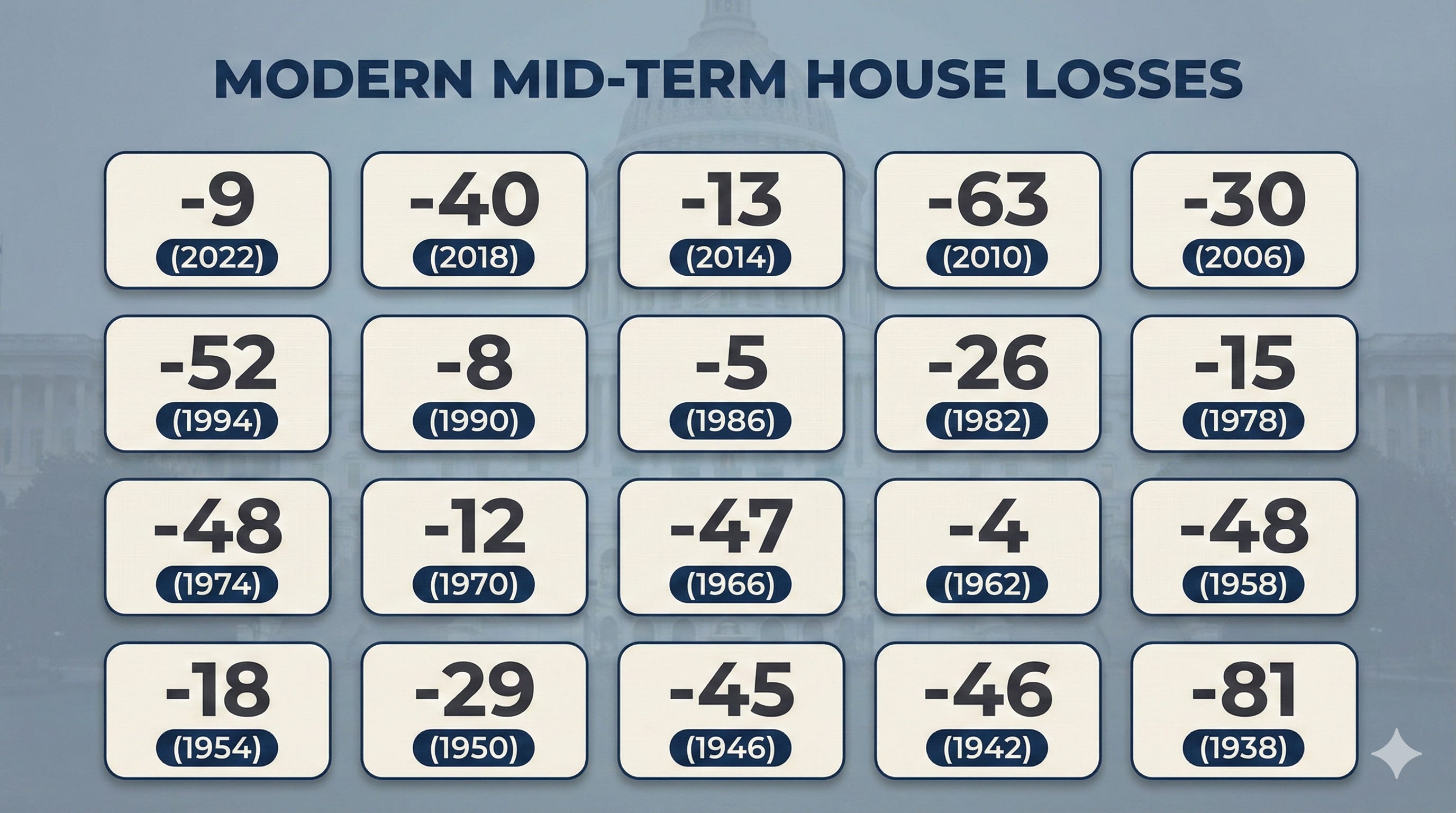
In plain English: carnage.
In fact, in the House, the party holding the presidency has only added seats in 2 of the last 22 midterm elections. That’s just 9% of the time.
If you’re a Republican strategist trying to break the trend, good luck and Godspeed.
There’s a little more reason for optimism in the Senate, but not much. The president’s party has gained seats in 6 of 21 elections (about 29%), with one election ending flat.
There are exceptions. In 2002, right after 9/11, when national unity (mostly around the love of the newly released movie Gigli) dominated everything. Another exception was in 1998, which some attribute to backlash from the Clinton impeachment, though the gains were modest and arguably just a partial rebound from the 1994 wipeout.
The takeaway isn’t that election outcomes are predetermined or statistically guaranteed. What you want to remember is the default gravity of midterms pulls against the party in power.
Limitations: Why This Isn’t a Race-by-Race Breakdown
Remember, we’re setting the baseline.
As Predictable grows, we’re going to get much more granular — specific races, candidates, and individual markets. We’re not doing that on the midterms today, and there’s a simple reason:
We don’t even know the candidates yet.
Candidate quality matters. A lot. There’s a reason “unknown Democrat” and “unknown Republican” always poll well — it’s because they haven’t been caught sleeping with a Chinese spy…yet. We don’t know what kind of slop we’ll be presented with, and pretending we can lock in results a year in advance is how you end up sounding confident — and missing badly.
Playing Field: The Senate Is Not the House
The House is vibes. Pure vibes. National mood swings, short attention spans, and a collective case of political ADHD. We get sick of whoever’s in charge after about eighteen minutes.
The Senate, however, is different.
The Senate has a predetermined starting point. Only one-third of the seats are up at any given time, which is why Senate results often don’t track with House results — even in an ugly national environment.
In the Senate, the scoreboard isn’t blank to start. Some years, losing a seat is a solid outcome. In other years, gaining seats can be a disappointment. It all comes down to the map.
So, let’s see what the map looks like right now.
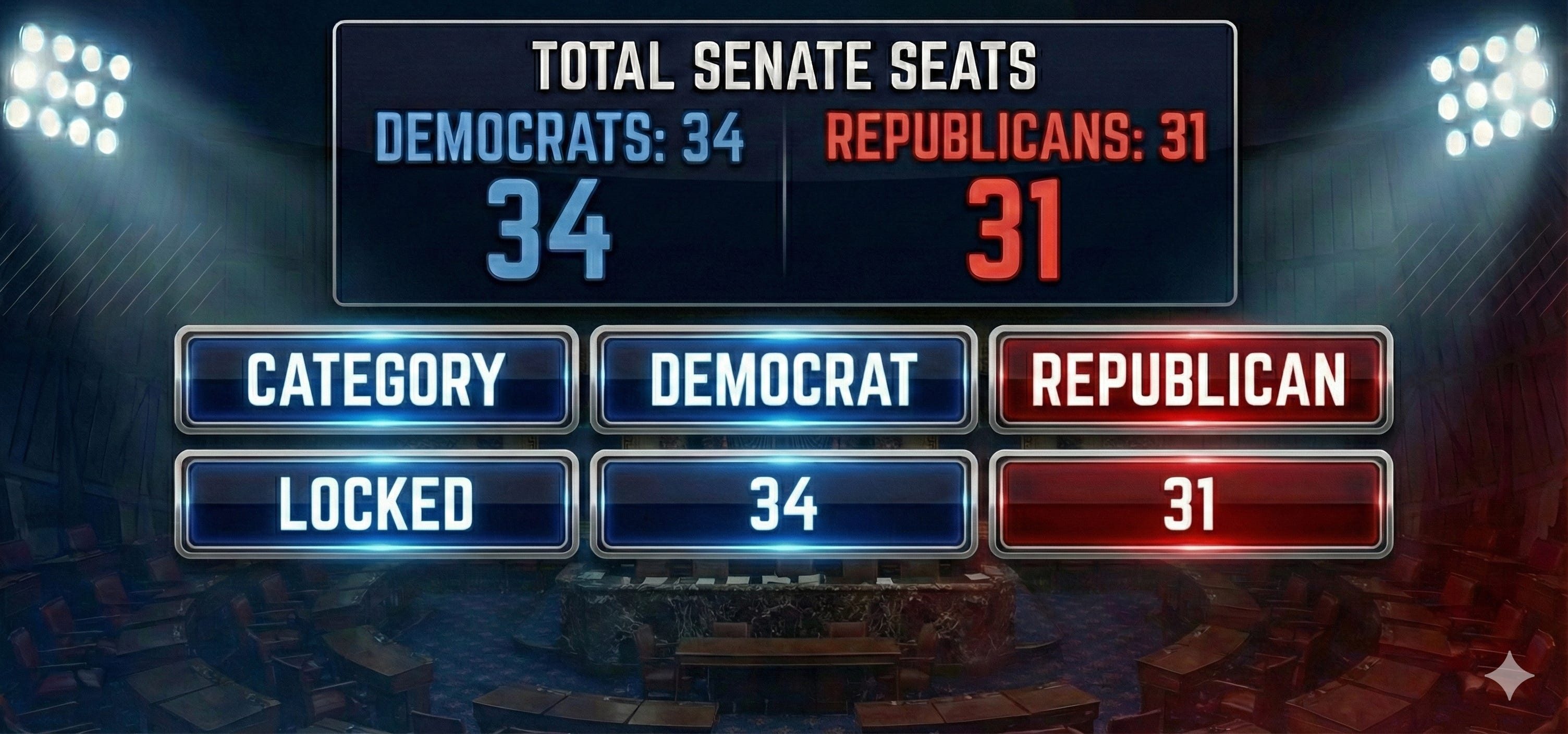
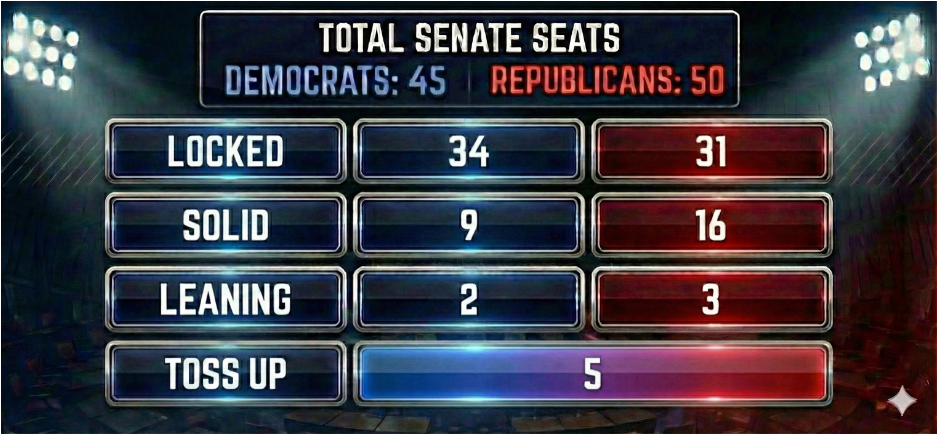
Locked Seats: The Floor for Each Party
The first step to control of the Senate starts with what isn’t even in play.
On the Democratic side, 34 seats are locked and not up for election.
On the Republican side, 31 seats are locked.
This is the floor. Everything else builds on top of it.
Solid Seats: Yawn.
These are races that aren’t locked, but also should not be very competitive. If your party starts losing these, you might be going the way of the Whigs.
Solid Democrats: 9 (CO, DE, IL, MA, NH, NM, OR, RI, VA)
Solid Republicans: 16 (AL, AR, FL, ID, KS, KY, LA, MS, MT, NE, OK, SC, SD, TN, WV, WY)
Add those to the locked seats, and the scoreboard looks like this:
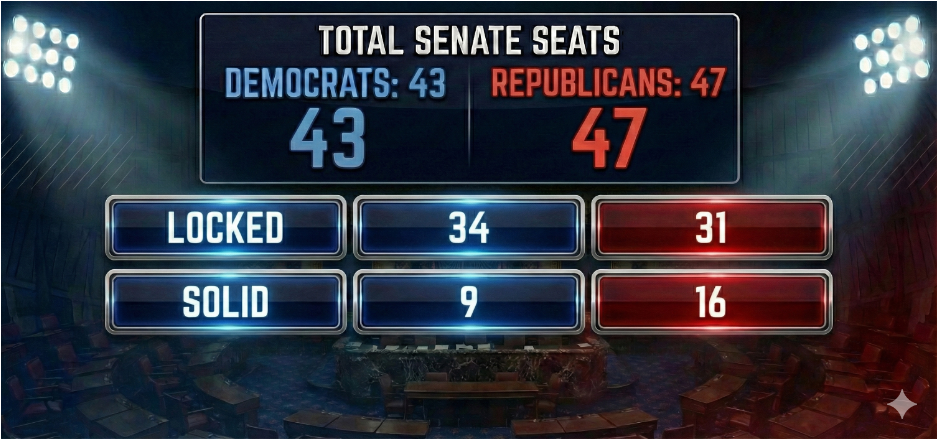
Before we even get to the interesting races, Republicans sit only three seats (plus JD Vance) away from holding the Senate.
Leaning Seats: Where Things Get Weird
Quick repeat disclaimer: There is not enough information yet to really know who is leaning where. We’ll eventually break this down with individual races, with additional categories.
Why can’t we do that now?
Because politics is chaos. You never know when a rich guy will casually include your favorite candidate’s name in an email about an island. A single bad headline can reshape an entire race overnight. In short: we have no idea what wonderful nonsense is still in store for all of us.
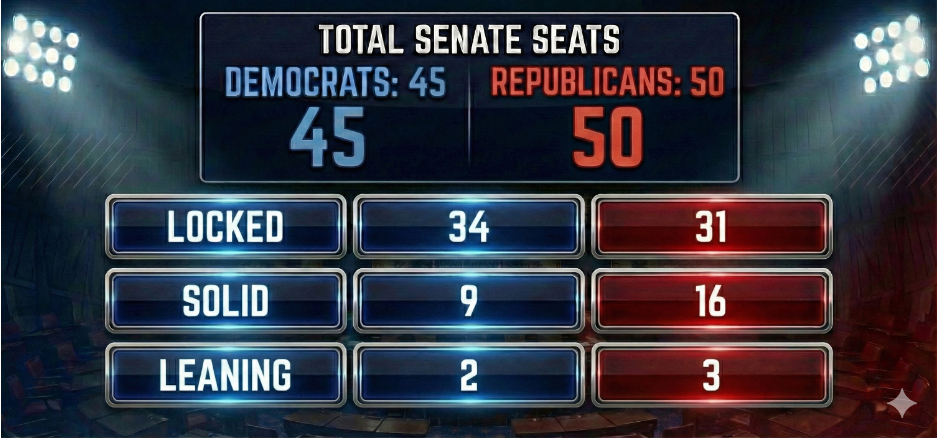
Currently, here are the leaners:
Leaning Democrats: 2 (MN, NH)
Leaning Republicans: 3 (OH, IA, TX)
Updated scoreboard:
Toss-Ups: The Problem Children
We have five races that I’m currently considering toss-ups.
It makes sense to take a broad view of toss-ups this early, and honestly, we could probably be safe and throw all of the leaners in this category, but what fun is that?
Current toss-up list:
Georgia
Maine
Michigan
North Carolina
Alaska (yes, Alaska)
The Big Picture
By looking at this breakdown, the overall picture is pretty clear. Republicans really should maintain control of the Senate. It might not be pretty, they might lose some states the Democrats have no right winning. But, even with all the challenges of history stacking up on top of a difficult year, Republicans should be able to hold things together.
And for the moment, that is generally what the main market reflects. Polymarket shows around a 63% chance (at the time of this writing) for Republicans to hold on:
Polymarket data sourced via partnership.
The table above pulls live data from Polymarket and reflects current odds. The screenshot below was accurate at the time of publishing and may differ.
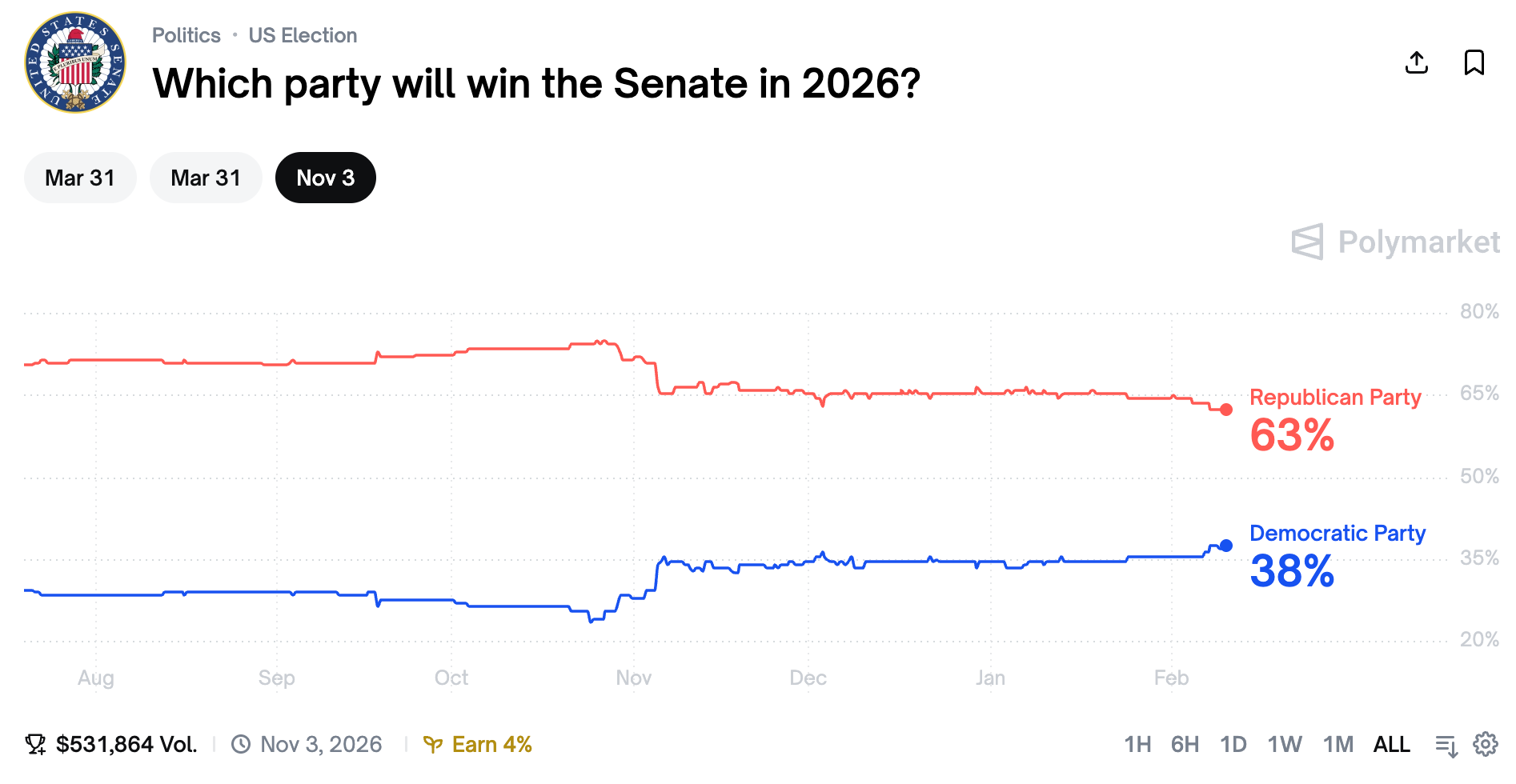
At first glance, you’d think Republicans might feel pretty good about these numbers, after all, they are projected to win about twice as much as they lose. But relative to the map they’re defending, this outcome would be… shall we say… suboptimal.
Where’s the Value?
Up to now, we’ve been focused on understanding the upcoming election — the baseline, the map, and what outcomes are most likely. Let’s shift gears and talk market specifics. Just because the election is ten months away doesn’t mean we can’t get early indications for investments that might be interesting.
Quick thought to keep in mind: right now, the only election markets worth touching are those you expect to move in the near term. If you think the market will remain stable, you can deploy your capital elsewhere and come back to it later.
In other words, making 30% in 10 months is a nice return, but it’s not nearly as good as making 20% in 2 months. Why? Because in the first scenario, your annual percentage yield (APY) is 37%. Nice. But, in the second scenario, the compounded APY is nearly 200%. Nicer.
So, what we’re looking for is value that we want to catch now, because it might go away later. With that in mind, here are a couple of potential opportunities that might be worth beginning to build a position in:
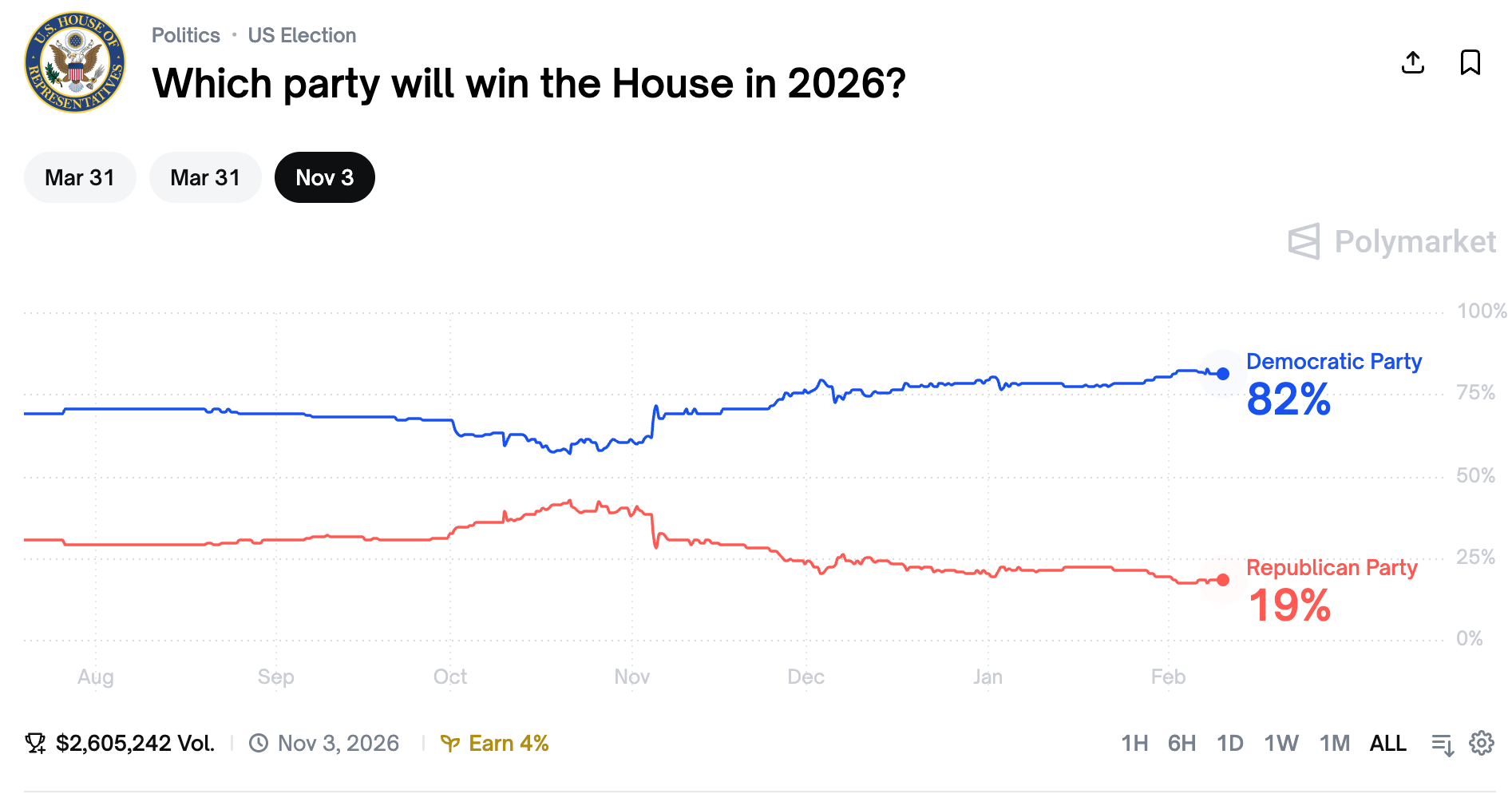
Democrats winning the House: Full disclosure, this brings me no joy. But an investment made in the Dems to take the House gives you about a 22% return, (18 cents profit on every 82 cents invested) with an APY of 31%. Frankly, I liked this investment more in late 2025, when it was around 70%, and I loved it before election day ‘25, when it was hanging around the low 60s. It’s highly likely there will be an opportunity to beat the APY in this market before November, but building a position here isn’t the worst idea.
The table above pulls live data from Polymarket and reflects current odds. The screenshot below was accurate at the time of publishing and may differ.
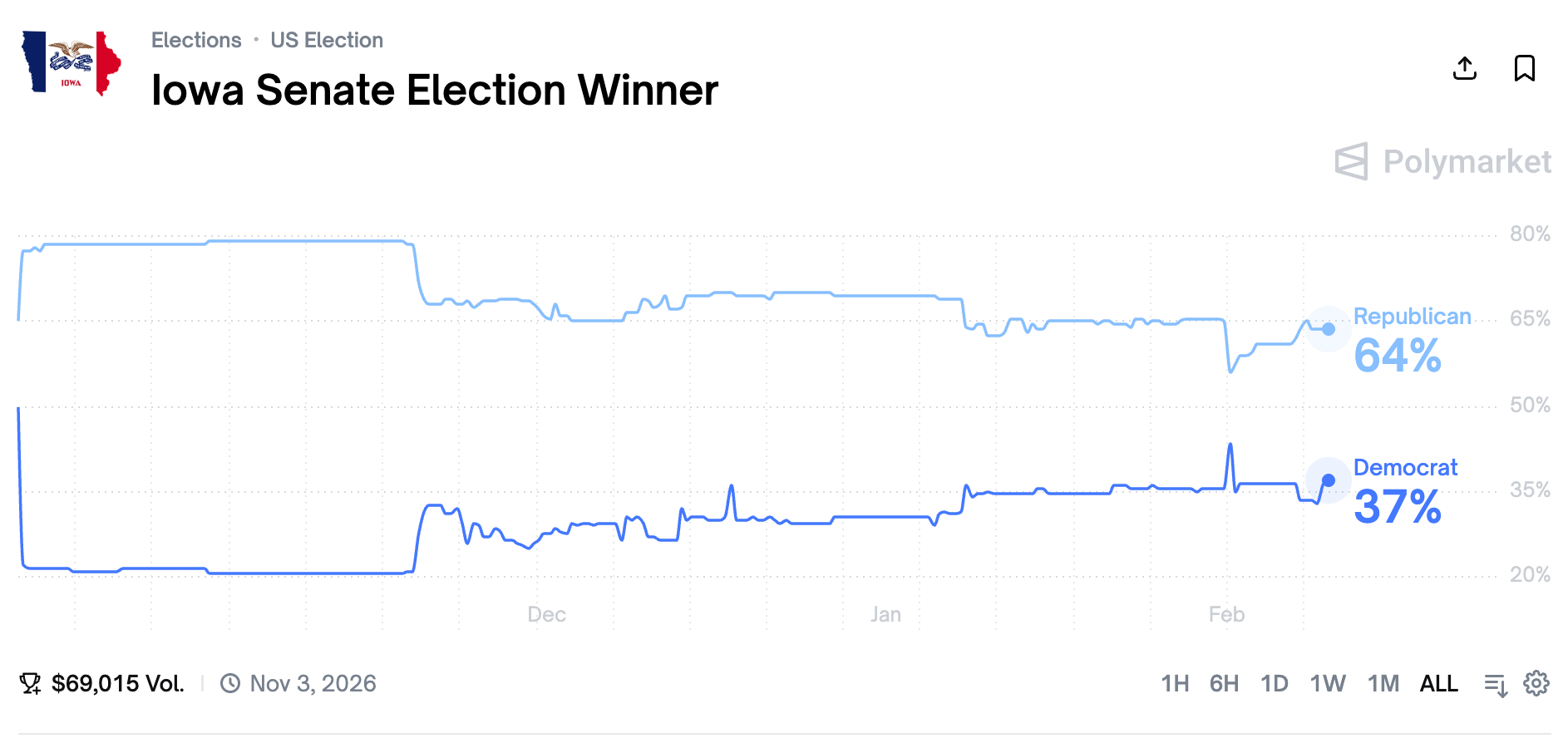
Republicans winning the open Iowa Senate seat: This seat is open due to Joni Ernst deciding not to run for reelection. Iowa, a state that has been trending red over the years, should be a lock for Republicans even in a tough year. In theory.
Yet, Polymarket will let you pick up the Republican win this race at 64%, which would work out to a 56% profit (36 cents earned on 64 cents = 56.25%), or an APY of 85% (56% return over ~8.7 months to the Nov 3 resolution). What is happening here seems to be related to the Democrats in Iowa fielding a strong candidate for Governor, after another retirement of an incumbent Republican. This is causing optimism generally for democrats in the state, along with special election results that democrats have seen as promising. This might be good for their short term mental health, but mere hopium shouldn’t be moving this market as much as it is.
It’s certainly not impossible to see upsets in Iowa, as we saw in the Obama era. But a Republican loss in this race would put the GOP in potentially catastrophic territory.
The table above pulls live data from Polymarket and reflects current odds. The screenshot below was accurate at the time of publishing and may differ.
TL;DR
Republicans are in more trouble than they should be, given the playing field, but they should still be considered the favorites at this point. Even with the structural challenges of a midterm, they’d still have to choke to blow it.
Never underestimate the chances of Republicans doing just that.
We’re still building this Death Star. There’s a lot more coming — deeper race-by-race breakdowns, market opportunities, and the kind of analysis that focuses on incentives instead of narratives. Once Predictable (the show) gets going, you’ll find it at YouTube.com/StuDoesAmerica, and on the same podcast feed as Stu Does America.
Go ahead and SUBSCRIBE RIGHT NOW — future you (and future you’s bank account) will appreciate it.
FINANCIAL DISCLAIMER
Predictable provides information and commentary for educational and informational purposes only. Nothing published by Predictable should be considered financial, investment, legal, or professional advice, or a recommendation to buy, sell, or participate in any market or product. Prediction market odds and analysis are time-sensitive and subject to change. You are solely responsible for any decisions you make based on this content. Participation in prediction markets involves risk, and past performance or analysis is not indicative of future results. Certain platforms and markets may be restricted based on jurisdiction. Polymarket data sourced via partnership.
Second week not gonna lie.show already not the same..you knew when to jump in..new people Glen has to ask them,they seem gun shy.i never quit GLENN just saying nobody is unreplaceable but some shoes cant be filled.🤌🇮🇹🇺🇸
Insightful with humor - Just what we expect from you! Looking forward to more. Thanks!